
Why Veterinary Ultrasound and Echocardiograms Matter Even When Your Pet Seems Healthy

When your dog or cat seems perfectly normal at home, it can be difficult to understand why a veterinarian might recommend advanced diagnostic imaging.
They are eating.
They are playing.
They are sleeping normally.
Maybe they are not showing any obvious signs of illness at all.
Yet sometimes the first indication that something deserves a closer look comes from information that is much easier to miss at home.
A blood test may show an unexpected change. A veterinarian may hear something unusual during a routine examination. A pet may have a subtle change that does not seem significant enough to warrant concern on its own. Or a veterinarian may simply want a better understanding of what is happening inside the body before making an important medical decision.
This is where veterinary ultrasound and echocardiograms can provide valuable information.
Advanced imaging is not only about investigating pets that are visibly sick. It can also help veterinarians take a closer look when something does not quite add up.
At Veterinary Diagnostics Centers, our approach to ultrasound and echocardiography is focused on helping veterinarians see more of the patient and make decisions based on better information. Our patients cannot tell us where something feels different or explain a subtle change in how they feel. Imaging can give the veterinary team another way to investigate those questions.
Sometimes, the goal is to identify disease.
Sometimes, it is to better understand a finding that appeared during a routine examination.
And sometimes, it is simply to make sure there is not an important problem hiding beneath an otherwise normal appearance.
Pets Can Look Healthy While Something Is Changing Internally
One of the challenges of veterinary medicine is that dogs and cats are very good at hiding changes in their health.
A pet may continue eating, walking around the house, and interacting with the family even when something inside the body is beginning to change.
This does not mean that every healthy-looking pet needs advanced imaging.
It means that appearance alone does not always provide the complete picture.
Veterinarians often rely on a combination of physical examination, medical history, laboratory testing, radiographs, ultrasound, and other diagnostics to understand what is happening inside a patient.
The uploaded Veterinary Diagnostics Centers material specifically describes situations in which pets may appear normal at home while blood work reveals abnormalities that warrant further investigation.
That is one reason diagnostic imaging can be valuable even when a pet does not look obviously ill.
The goal is not to search for something wrong simply because a pet is getting older or because an imaging test exists.
The goal is to investigate a meaningful medical question when the veterinarian believes additional information could help.
Routine Wellness Care Can Reveal Questions That Need More Answers
Wellness visits are about more than vaccinations and checking whether a pet looks healthy.
A physical examination gives the veterinarian an opportunity to evaluate the pet from head to tail.
Laboratory testing may provide information about internal organ function.
And when something raises a question, advanced imaging can provide another level of information.
For example, a pet may have an unexpected laboratory abnormality without obvious clinical signs.
A veterinarian may want to know whether the finding corresponds to a visible change in an internal organ.
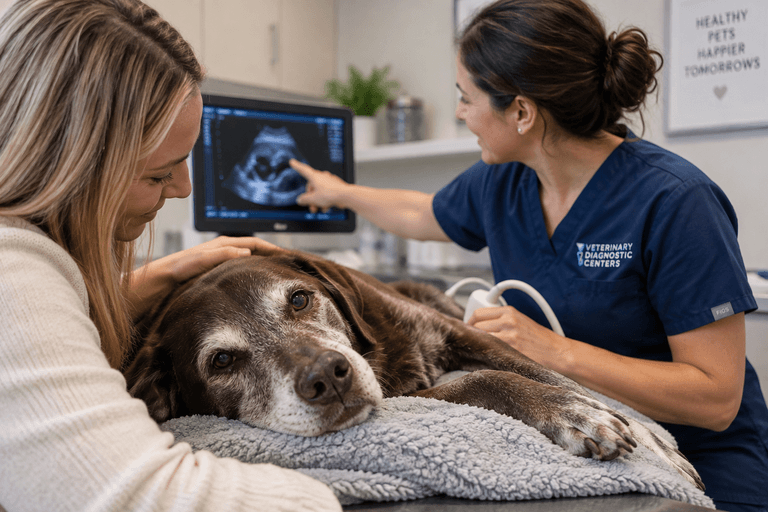
Ultrasound can provide real-time images of structures such as the liver, gallbladder, kidneys, bladder, pancreas, spleen, intestinal tract, and lymph nodes.
That additional information can help put a laboratory result into context.
Instead of looking at a number on a report by itself, the veterinary team may be able to evaluate whether there is a corresponding structural change.
Veterinary Ultrasound Gives Us a Different View of the Body
Different diagnostic tools answer different questions.
X-rays can provide valuable information about the overall size, shape, position, and density of structures.
Ultrasound offers a different perspective.
It uses sound waves to create real-time images and allows the veterinary team to evaluate internal architecture and movement.
That makes it particularly useful when the question involves soft tissues or internal organs.
This distinction is important because no single diagnostic test provides every type of information.
A veterinarian may use blood work to evaluate organ function.
Radiographs may help assess overall anatomy.
Ultrasound can provide additional detail about internal structures.
An echocardiogram can provide specialized information about the heart.
Each piece adds to the overall understanding of the patient.
Small Changes Can Be Worth Investigating
One of the most valuable parts of veterinary care is recognizing when a small finding deserves more attention.
A subtle laboratory abnormality does not necessarily mean that a serious disease is present.
A heart murmur does not automatically mean that a pet has advanced heart disease.
A slight change in a pet’s behavior does not necessarily point to one specific diagnosis.
But these findings can create questions.
Advanced imaging can help answer some of those questions.
This is where wellness and diagnostic medicine overlap.
The objective is not to make every minor change sound alarming.
It is to make sure that potentially meaningful findings are evaluated appropriately.
Sometimes additional imaging provides an explanation.
Sometimes it provides reassurance.
Sometimes it shows that the veterinarian should investigate another direction.
All three outcomes can be useful.
Why Veterinary Ultrasound Can Be Valuable Before Symptoms Become Severe
When a condition becomes severe, the diagnosis may be more obvious.
The challenge is that waiting until a pet becomes visibly sick is not always ideal.
By the time a dog or cat stops eating, becomes weak, develops significant breathing difficulty, or experiences repeated vomiting, the underlying problem may already be more advanced.
The source material emphasizes that ultrasound can identify abnormalities and help guide decisions before conditions become more serious.
That does not mean ultrasound should be performed routinely on every healthy pet.
Instead, when a veterinarian identifies a reason to investigate further, imaging can help provide information while the patient may still appear relatively well.
This can be particularly meaningful for pets whose early changes are subtle.
Cats Can Be Especially Difficult to Read
Cats have a reputation for hiding illness.
Often, that is exactly what they do.
A cat may continue its normal routine while gradually losing weight, eating slightly less, becoming less active, or changing its behavior in ways that are easy to overlook.
The existing blog material notes that cats can hide illness longer than dogs and that feline intestinal disease can be difficult to diagnose early.
That makes careful observation and appropriate diagnostic follow-up especially important.
When a veterinarian has a reason to investigate an internal problem, abdominal ultrasound can provide information about structures that cannot be evaluated adequately through an external examination alone.
The scan does not replace the veterinarian’s assessment.
It adds another view.
A Healthy Appearance Does Not Tell Us Everything About the Heart
The heart is another example of why outward appearance does not always tell the entire story.
A dog may still enjoy walks even when an early cardiac abnormality is developing.
A cat may not show obvious signs until heart disease is more advanced.
Sometimes the first clue is something a veterinarian detects during an examination.
A murmur or abnormal rhythm can create a reason to look more closely.
An echocardiogram is a specialized cardiac ultrasound that evaluates the heart in real time. It can provide information about valves, blood flow, wall thickness, chamber size, pumping function, pulmonary pressures, and heart muscle disease.
That is information that cannot be obtained simply by watching a pet walk around the house.
Why an Echocardiogram Provides More Detail Than a Heart X-Ray
Chest X-rays can be useful for evaluating the overall size and shape of the heart.
But they do not provide the same internal detail as an echocardiogram.
As discussed in the transcript, an echocardiogram allows the veterinary team to see the valves and evaluate measurements involving blood flow, velocities, direction, and wall thicknesses.
This is why echocardiography can be so valuable when a veterinarian has a question about cardiac function.
It is not simply another picture of the heart.
It is a way to evaluate how the heart is structured and how it is working.
An Echocardiogram Can Help Put a Murmur Into Context
Hearing that your pet has a heart murmur can be unsettling.
But a murmur by itself does not tell the entire story.
The veterinarian may need to determine whether there is an underlying structural abnormality and, if so, how significant it is.
An echocardiogram can provide the additional information needed to evaluate that question.
The Veterinary Diagnostics Centers material explains that echocardiography can help determine whether heart disease is mild or advanced, which structures are affected, whether medication may be necessary, and how closely the condition should be monitored.
That makes the test useful not only for diagnosis but also for planning future care.
Imaging Can Help Before Anesthesia
Another situation where advanced cardiac imaging may be considered is before anesthesia.
If a veterinarian has identified a murmur, arrhythmia, or other concern and the pet needs anesthesia for a procedure, understanding the heart’s condition can be important for planning.
The transcript specifically identifies a heart murmur or arrhythmia in a patient who is expected to undergo anesthesia as a situation where an echocardiogram should be considered.
Again, this is not about assuming that something is wrong.
It is about gathering information that can help the veterinary team understand the patient’s cardiovascular status before making a medical plan.
Ultrasound Can Help Connect Different Pieces of Information
Veterinary diagnosis is often a process of putting pieces together.
A pet’s blood work may suggest one possibility.
The physical examination may raise another question.
The medical history may provide additional context.
Imaging can help determine whether these pieces appear to fit together.
For example, an abnormal laboratory result may prompt an abdominal ultrasound.
A heart murmur may prompt an echocardiogram.
Persistent symptoms may lead to imaging when routine diagnostics have not provided enough information.
The source material describes ultrasound as particularly useful when blood work provides incomplete answers, X-rays are inconclusive, symptoms persist without a clear explanation, or soft-tissue disease is suspected.
That makes advanced imaging part of a broader diagnostic conversation.
The Goal Is Better Information, Not More Testing
It is important to make a distinction between appropriate diagnostic imaging and unnecessary testing.
More tests are not automatically better.
The value of a test comes from whether it answers a meaningful clinical question.
A veterinarian may recommend ultrasound because the results could change what happens next.
They may recommend an echocardiogram because understanding the heart’s structure and function could influence treatment or monitoring.
Or they may decide that imaging is not necessary.
That decision should always be based on the individual patient.
Our role in veterinary diagnostics is to provide useful information when advanced imaging is appropriate—not to turn every routine wellness visit into an imaging appointment.
What Happens When the Imaging Is Reassuring?
A reassuring result can be valuable.
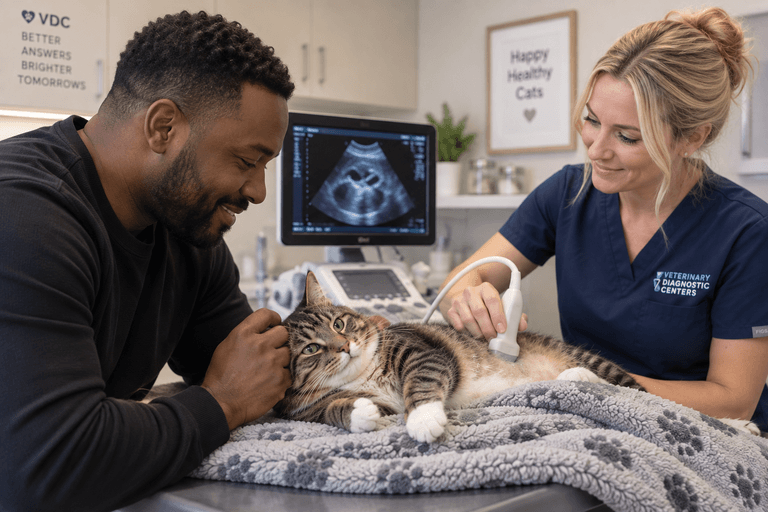
If an ultrasound does not identify the suspected abnormality, the veterinarian has another piece of information to consider.
If an echocardiogram shows that the heart structures and function are reassuring, that can help put a murmur or other concern into context.
A normal or reassuring result does not mean that every possible medical condition has been ruled out.
But it can help narrow the diagnostic process.
The existing material specifically notes that ruling out serious conditions can be just as important as identifying them.
That is an important part of wellness-focused veterinary medicine.
Sometimes the information we gain is about what is not happening.
What If Imaging Finds Something Small?
Not every abnormality requires immediate intervention.
Some findings may simply need to be documented and monitored.
Others may require additional testing.
Still others may change the treatment plan.
The important thing is that imaging gives the veterinary team more information with which to make that decision.
Ultrasound may identify a structural change, but additional diagnostics can sometimes be necessary to determine exactly what it represents. The source material notes that fine-needle aspiration, cytology, biopsy, additional blood work, CT, or follow-up imaging may be appropriate depending on the situation.
The scan therefore becomes part of a thoughtful process rather than a standalone answer.
The Person Performing the Ultrasound Matters
One of the less obvious aspects of veterinary ultrasound is how much skill is involved in obtaining useful images.
Ultrasound is not simply a matter of placing a probe on the pet and pressing a button.
The examination is performed in real time.
The person performing the scan needs to know what structures should look like, recognize when something appears unusual, adjust imaging angles, and work around challenges created by anatomy, movement, body size, or intestinal gas.
The source material describes ultrasound as highly operator-dependent and emphasizes the importance of experience in recognizing subtle abnormalities and obtaining diagnostic-quality images.
This is especially important when the changes being investigated may be subtle.
A Calm Approach Matters for Wellness-Focused Diagnostics
Advanced imaging should not be thought of as a stressful experience simply because it involves sophisticated equipment.
Many pets tolerate ultrasound well.
The procedure itself is non-invasive, and many patients can remain awake during the examination. The existing material explains that sedation is not required for many veterinary ultrasounds, although it may occasionally be recommended for pets that are highly anxious, painful, unable to remain still safely, or undergoing an additional procedure.
Keeping the experience as calm as possible is important.
A pet that is comfortable is easier to examine, and a lower-stress environment can make the imaging process easier for everyone involved.
Wellness Means Paying Attention Before There Is a Crisis
Preventive veterinary care is not about expecting something to go wrong.
It is about giving your pet the best opportunity to stay healthy and addressing meaningful concerns when they arise.
That may mean routine examinations.
It may mean blood work.
It may mean monitoring a known condition.
And in some cases, it may mean taking a closer look with ultrasound or an echocardiogram.
Advanced imaging has a place in wellness-focused medicine because it can provide information that is difficult or impossible to obtain from an external examination alone.
The decision to perform imaging should always come from a medical reason.
But when that reason exists, having access to detailed information can make a meaningful difference.
Why Real-Time Imaging Is So Valuable
One of the defining features of ultrasound is that it allows the veterinary team to see structures in real time.
This matters because the body is not static.
Organs move.
The heart beats.
Blood flows.
The sonographer can adjust the examination based on what is being observed.
That dynamic aspect is especially important in echocardiography.
The heart is constantly moving, and understanding its function requires more than a single still image.
The transcript emphasizes this distinction by describing echocardiography as a way to look inside the heart and measure valves, blood flow, velocities, directions, and wall thicknesses.
This level of information can help transform a general concern into a much clearer medical picture.
Giving Veterinarians More Information to Work With
At the end of the day, the purpose of veterinary ultrasound and echocardiograms is not simply to produce impressive images.
The images matter because of what they can tell the veterinary team.
They can help investigate an abnormal blood test.
They can provide more information about an organ.
They can help evaluate the heart after a murmur is detected.
They can help determine whether an area needs additional attention.
They can provide information before anesthesia.
And they can sometimes provide reassurance when the structures being evaluated appear healthy.
For pet owners, that can be an important distinction.
Advanced imaging is not only something reserved for the moment when a pet is obviously sick.
When there is a meaningful medical question, ultrasound and echocardiography can help veterinarians investigate that question with greater detail.
At Veterinary Diagnostics Centers, we believe better diagnostics begin with better information.
Our goal is to provide veterinarians with high-quality imaging that helps them understand what is happening inside their patients and make informed decisions about the care that follows.
For dogs and cats, that additional information can be especially valuable.
They cannot tell us when something feels different.
They cannot explain a subtle symptom.
They cannot describe what is happening inside their body.
But with the right diagnostic tools, we can look more closely.
And sometimes, that closer look is exactly what helps keep a pet on the healthiest path possible.